The Singapore-Cambridge GCE A-Level General Paper (GP) is not just an English subject. It is a paper that tests critical thinking, logical writing, awareness of global and social issues, and the ability to express ideas clearly and effectively. Many students assume GP is mainly about having strong English, but in reality, students who do well are usually those who can interpret questions accurately, build strong arguments, and support their views with relevant examples.
If you want to achieve an excellent grade in GP, you need more than memorized content. You need a smart strategy.
1. GP is a thinking paper, not a memorization paper
One of the biggest misconceptions about GP is that students need to memorize as many current affairs examples as possible. While examples are important, GP is not a test of how many facts you know. It is a test of how well you can analyze issues, evaluate arguments, and present a balanced view.
For example, if the question asks, “Does technology make people more free?”, a weak answer may simply list examples such as social media, AI, and smartphones. A strong answer, however, will go further. It will define what “freedom” means, explore how technology increases freedom in some ways and limits it in others, and then arrive at a careful conclusion.
In other words, GP rewards students who can think deeply, not just students who know many examples.
2. The key to Paper 1 is understanding the question correctly
In essay writing, many students lose marks not because they cannot write, but because they misunderstand the question. This is one of the most common reasons why GP essays remain average.
Before writing, you must always break down the question carefully.
Pay attention to:
- Key concepts: for example, freedom, success, fairness, progress
- Instruction words: discuss, to what extent, how far, assess
- Scope words: in your society, today, among young people, in modern democracies
- Absolute words: always, never, only, nothing but, inevitable
Take this example:
“Advertisements are nothing but lies.” Discuss.
This question is not asking for a general essay about advertising. The key phrase is “nothing but”, which is an extreme claim. A strong answer should evaluate whether this is fully true, partly true, or mostly false. The best essays do not simply agree or disagree. They show nuance.
3. Strong GP essays are balanced, not one-sided
Some students think that taking a very strong position automatically makes an essay more impressive. That is not always true. In GP, high-scoring essays usually show balance, maturity, and awareness of different perspectives.
This means that instead of arguing aggressively for one side only, you should:
- present your main argument clearly
- consider opposing views
- explain their strengths and limitations
- arrive at a reasoned judgment
A strong GP essay often sounds thoughtful rather than extreme.
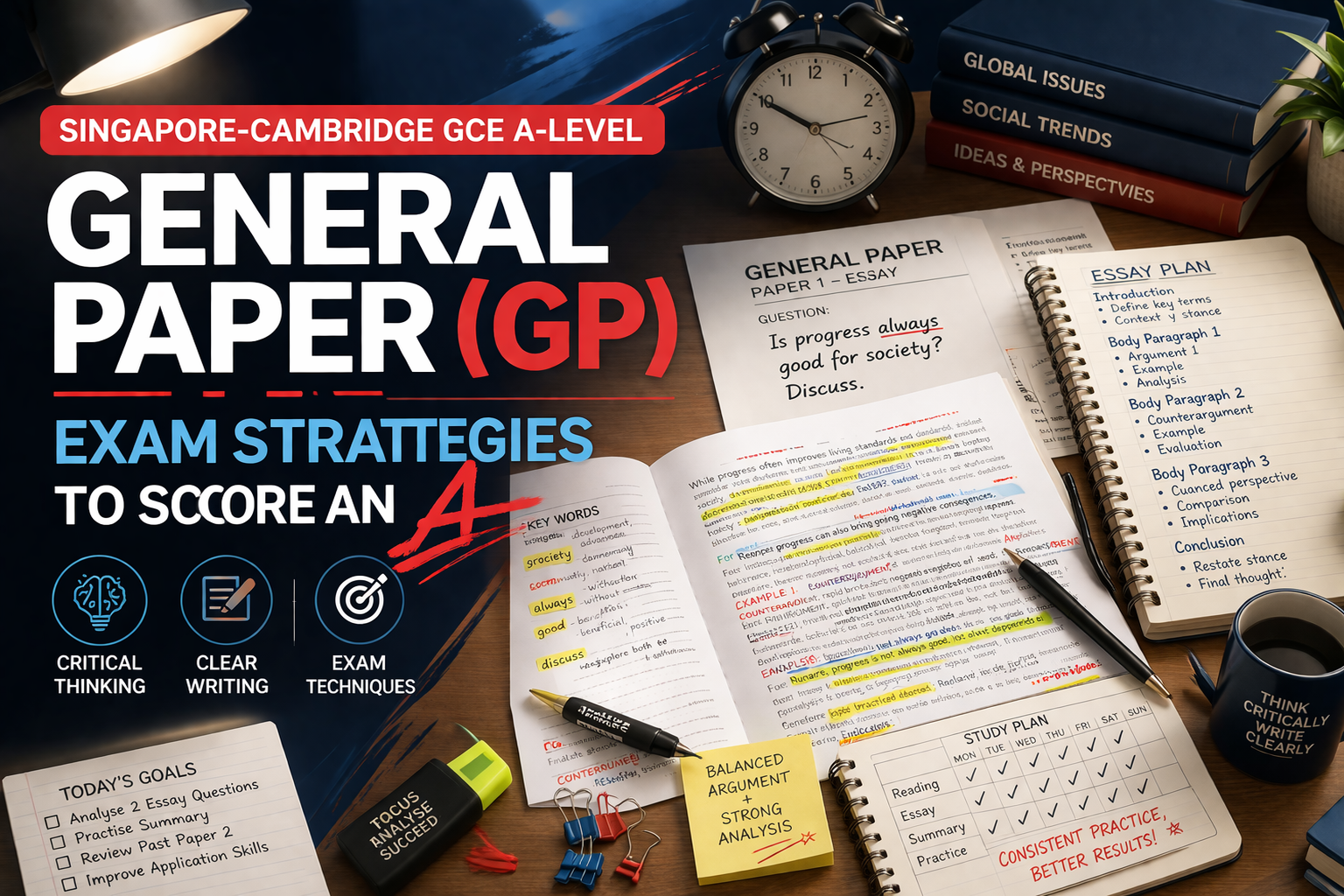
A useful essay structure:
Introduction
- define the key terms
- identify the issue
- state your overall position
Body Paragraph 1
- first main argument
- example
- explanation and analysis
Body Paragraph 2
- opposing view or limitation
- supporting example
- evaluation
Body Paragraph 3
- a more nuanced or conditional argument
- comparison across contexts, countries, or groups
Conclusion
- return directly to the question
- give a final judgment
- show under what conditions your argument is strongest
This structure helps you stay focused and persuasive.
4. Examples matter, but only when used well
Examples are important in GP, but they do not help unless they are connected clearly to your argument. Some students include many examples but fail to explain their relevance. That weakens the essay.
A good example should always do three things:
State the example -> Explain its significance -> Link it back to the question
For instance:
- State the example: Generative AI is increasingly used in education and the workplace.
- Explain its significance: It improves efficiency and access to information, but also raises concerns about reliability, plagiarism, and overdependence.
- Link it to the question: Therefore, technology can expand human ability, but without proper boundaries, it may also weaken independent judgment.
This is how examples become part of an argument rather than just extra information.
5. Build an “argument bank,” not just a content bank
Because GP covers a wide range of topics such as science, politics, media, education, environment, and culture, many students feel overwhelmed. They try to study everything. That approach is exhausting and usually ineffective.
A better method is to build an argument bank. For each major topic, prepare common lines of argument that can be adapted to different questions.
For example:
Science and Technology
- greater efficiency and convenience
- privacy concerns and surveillance
- reduced human judgment
- the challenge of regulation
Environment
- conflict between growth and sustainability
- unequal responsibility among countries
- the limits of individual action
- the role of governments and corporations
Media
- wider access to information
- misinformation and polarization
- influence of algorithms
- freedom of expression versus platform responsibility
When you prepare arguments in this way, you become more flexible in the exam.
6. Paper 2 is not just comprehension — it is analysis, comparison, and application
Many students treat Paper 2 as a normal reading comprehension exercise. That is a mistake. Paper 2 tests much more than basic understanding. It requires you to:
- identify the writer’s ideas and attitudes
- compare ideas across passages
- summarize effectively
- apply ideas from the passages to broader contexts
To do well, you need to read actively.
Focus on these four skills:
1. Identify the author’s argument and tone
Do not just ask, “What is the passage about?” Ask:
- What is the main claim?
- What evidence is used?
- Is the tone critical, cautious, optimistic, or skeptical?
2. Compare passages carefully
Do not read each passage in isolation. Notice:
- where the writers agree
- where they differ
- how their assumptions or priorities contrast
3. Practice summary writing
Summary is not copying sentences from the passage. It is the skill of identifying the core points and expressing them clearly and concisely in your own words.
4. Handle application questions intelligently
Application questions are not asking for random personal opinions. They are asking you to use the ideas from the passages and apply them meaningfully to real-life contexts. If your answer is disconnected from the passages, it will not score well.
7. Habits of students who improve in GP
GP is not a subject that improves through last-minute memorization. It improves through consistent practice.
Here are five effective weekly habits:
Read quality English articles three times a week
You do not need to read for hours. Even a few well-chosen articles each week can help. As you read, note:
- one main claim
- one counter-argument
- one sentence or phrase that could be useful in GP
Practice brainstorming two essay questions a week
Take ten minutes for each question and jot down:
- definitions
- two supporting arguments
- two opposing arguments
- three relevant examples
You do not always need to write the full essay. Brainstorming is one of the best ways to improve quickly.
Do one summary practice a week
Choose a passage and summarize it in around 80 to 120 words. This sharpens your ability to identify essentials and express them efficiently.
Track your repeated mistakes
GP feedback is only useful if you review it properly. Keep a notebook of recurring weaknesses such as:
- misreading the question
- weak analysis
- vague examples
- poor conclusions
- excessive lifting in summary
Build your own example notebook
You do not need hundreds of examples. A smaller number of well-understood examples is far more useful. The goal is to use each example across multiple topics and questions.
8. Good time management can raise your score immediately
For Paper 1
Time management is crucial.
A useful guide is:
- 10 minutes: choose and analyze the question
- 10 minutes: plan your essay
- 55 minutes: write
- 15 minutes: review and improve
When choosing a question, do not simply pick the topic you know best. Pick the question you can answer most precisely.
For Paper 2
A few habits can help a lot:
- annotate comparison points as you read
- identify likely summary material early
- before answering application questions, list the key ideas from the passages first
Students who read with purpose usually perform much better than those who read passively.

9. Mistakes top GP students avoid
Students aiming for top grades should avoid the following:
Writing memorized essays
Examiners can tell when an essay has been forced onto a question.
Using examples without analysis
Examples alone do not impress. What matters is how clearly they support your argument.
Making extreme claims
Overly absolute arguments are often easy to challenge. GP values nuance.
Writing weak conclusions
A conclusion should not just repeat earlier points. It should give a clear final judgment.
Ignoring language accuracy
Good ideas matter, but so does clear expression. Grammar, sentence control, vocabulary, and precision all affect your performance.
10. Final thoughts
In the end, success in GP does not come from luck or from memorizing model essays. It comes from learning how to:
- understand the question accurately
- think critically
- present balanced arguments
- use examples meaningfully
- write clearly and precisely
Students who earn excellent grades in GP are usually not those with the fanciest vocabulary, but those who can read carefully, think deeply, and argue logically.
That is the real secret to doing well in Singapore-Cambridge GCE A-Level General Paper.